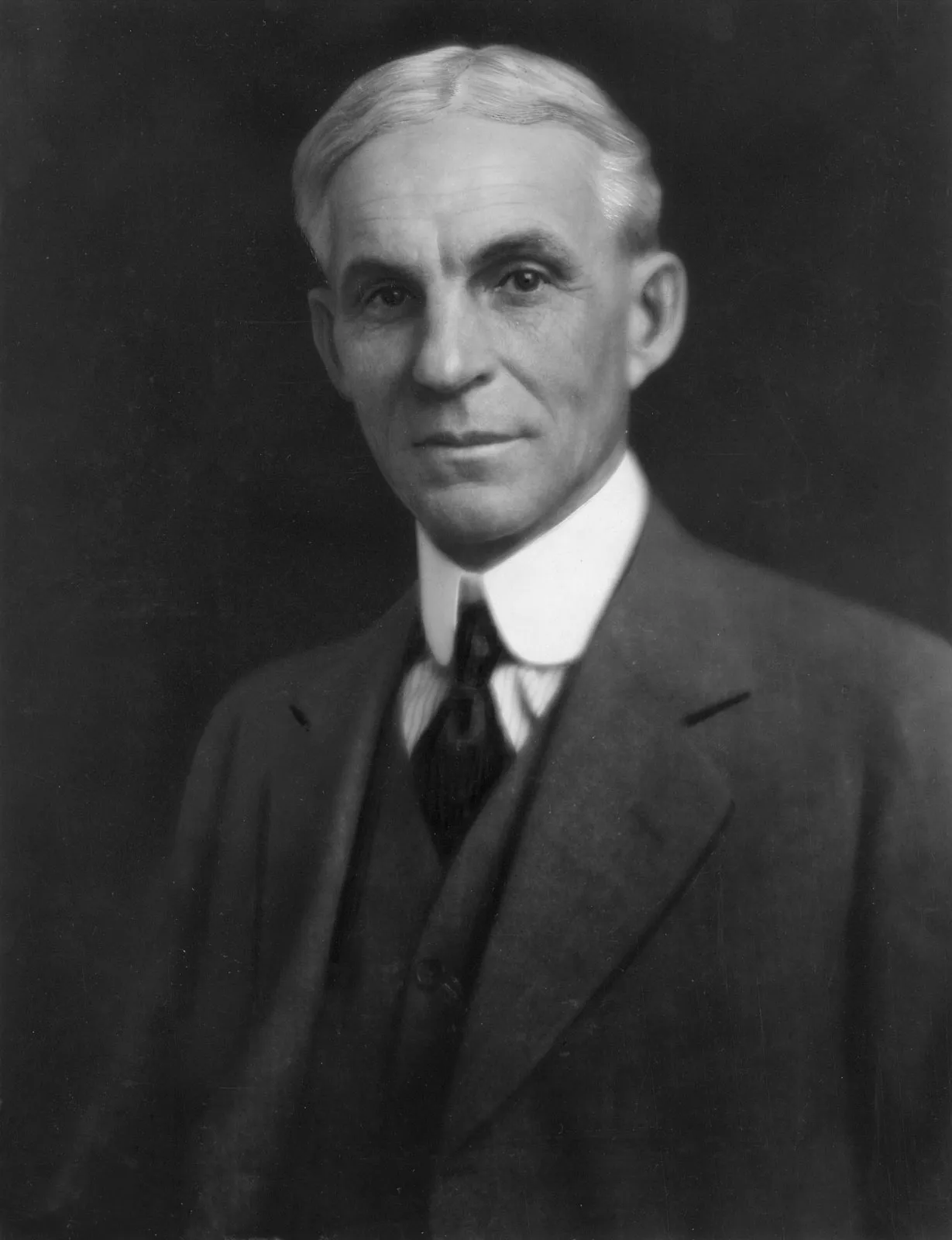
Henry Ford
An American industrialist and business magnate who revolutionized factory production with the moving assembly line.
born1863
died1947
nationalityAmerican
known forthe moving assembly line and the Model T automobile
fieldbusiness and manufacturing
- He founded the Ford Motor Company in 1903
- He introduced the Model T to make cars affordable for the average person
- He revolutionized manufacturing with the first moving assembly line
- He doubled worker wages, helping to build the American middle class
Timeline
1863Born in Greenfield Township, Michigan
1896Built his first experimental car, the Ford Quadricycle
1903Founded the Ford Motor Company
1908Introduced the Model T, a car for the masses
1913Installed the first moving assembly line for automobile production
1947Died in Dearborn, Michigan
background
Henry Ford was born in 1863 on a farm in Michigan. From a young age, he disliked farm work but was fascinated by machines. He often took apart watches and put them back together just to see how they worked. As a young man, he left the farm to work as an apprentice machinist in Detroit, eventually becoming a chief engineer at the Edison Illuminating Company. During his free time, he obsessively experimented with gasoline engines, leading to the creation of his first vehicle.
Henry Ford sinh năm 1863 trên một trang trại ở Michigan. Từ khi còn nhỏ, ông đã không thích công việc đồng áng nhưng lại bị mê hoặc bởi máy móc. Ông thường xuyên tháo tung những chiếc đồng hồ ra và lắp ráp chúng lại chỉ để xem cách chúng hoạt động. Khi còn trẻ, ông rời trang trại để làm thợ máy học việc ở Detroit, cuối cùng trở thành kỹ sư trưởng tại Công ty Chiếu sáng Edison. Trong thời gian rảnh rỗi, ông bị ám ảnh bởi việc thử nghiệm các động cơ xăng, dẫn đến việc tạo ra chiếc xe đầu tiên của mình.
achievement
In 1903, he founded the Ford Motor Company with the dream of building a car that the average person could afford. At the time, automobiles were expensive luxury items built one by one. In 1908, he introduced the Model T, a sturdy and reliable car. To meet the massive demand, Ford revolutionized manufacturing in 1913 by introducing the moving assembly line. Instead of workers moving around the car, a conveyor belt brought the car to the workers, with each person performing a single, repetitive task.
Năm 1903, ông thành lập Công ty Ô tô Ford với ước mơ chế tạo một chiếc xe mà người bình thường có thể mua được. Vào thời điểm đó, ô tô là những món đồ xa xỉ đắt tiền được lắp ráp thủ công từng chiếc một. Năm 1908, ông ra mắt mẫu Model T, một chiếc xe cứng cáp và đáng tin cậy. Để đáp ứng nhu cầu khổng lồ, Ford đã cách mạng hóa ngành sản xuất vào năm 1913 bằng cách giới thiệu dây chuyền lắp ráp di chuyển. Thay vì công nhân di chuyển quanh chiếc xe, một băng chuyền sẽ đưa chiếc xe đến chỗ công nhân, với mỗi người thực hiện một nhiệm vụ lặp đi lặp lại duy nhất.
impact
This method drastically reduced the time it took to build a car from over 12 hours to just 90 minutes. As production costs plummeted, Ford passed the savings on to customers, making the Model T wildly affordable. He also doubled his workers' wages to $5 a day, which helped create a middle class that could actually buy the products they made. Ford's pioneering of mass production not only transformed the automobile industry but also reshaped modern global manufacturing and urban society.
Phương pháp này đã giảm đáng kể thời gian chế tạo một chiếc ô tô từ hơn 12 giờ xuống chỉ còn 90 phút. Khi chi phí sản xuất giảm mạnh, Ford đã chuyển khoản tiết kiệm đó cho khách hàng, khiến chiếc Model T trở nên cực kỳ phải chăng. Ông cũng tăng gấp đôi tiền lương của công nhân lên 5 đô la một ngày, điều này giúp tạo ra một tầng lớp trung lưu thực sự có thể mua các sản phẩm họ làm ra. Việc Ford đi tiên phong trong sản xuất hàng loạt không chỉ biến đổi ngành công nghiệp ô tô mà còn định hình lại nền sản xuất và xã hội đô thị toàn cầu hiện đại.
Vocabulary
apprenticengười học việc
a person who is learning a trade from a skilled employer
một người đang học nghề từ một người chủ có tay nghề
obsessivelymột cách ám ảnh
in a way that shows you think about something constantly
theo một cách cho thấy bạn liên tục nghĩ về một điều gì đó
sturdycứng cáp / vững chắc
strongly and solidly built
được chế tạo mạnh mẽ và vững chắc
assembly linedây chuyền lắp ráp
a series of workers and machines in a factory by which a succession of identical items is progressively assembled
một chuỗi công nhân và máy móc trong nhà máy nhờ đó một loạt các mặt hàng giống hệt nhau được lắp ráp dần dần
repetitivelặp đi lặp lại
involving doing or saying the same thing several times
liên quan đến việc làm hoặc nói cùng một điều nhiều lần
plummetgiảm mạnh / lao dốc
to fall very quickly and suddenly
rơi rất nhanh và đột ngột
Knowledge Check
FACTUAL1 / 4
What was the name of the affordable car Ford introduced in 1908?
Flashcards
KNOWLEDGE
Who was Henry Ford?
An American industrialist who revolutionized factory production.
1 / 9