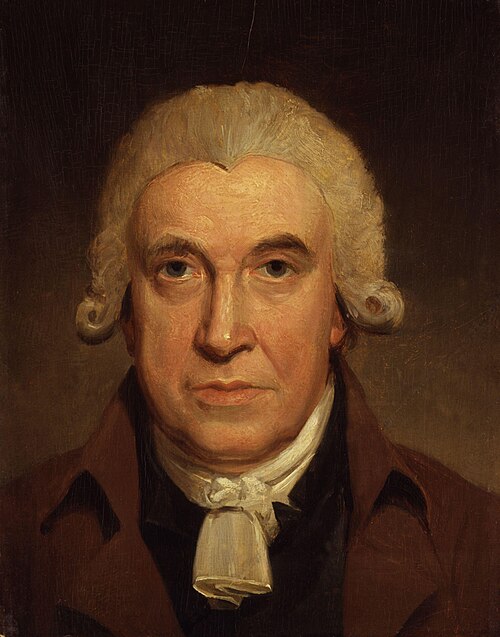
James Watt
A Scottish inventor and mechanical engineer who improved the steam engine, driving the Industrial Revolution.
born1736
died1819
nationalityScottish
known forimproving the steam engine
fieldmechanical engineering and inventing
- He invented the separate condenser to improve the steam engine
- He adapted the steam engine to produce rotary motion for factories
- He introduced the concept of horsepower
- His inventions played a central role in the Industrial Revolution
Timeline
1736Born in Greenock, Scotland
1755Traveled to London to study instrument making
1765Invented the separate condenser for the steam engine
1776Installed the first working Watt steam engines
1781Patented a steam engine that produced continuous rotary motion
1819Died in Birmingham, England
background
James Watt was born in 1736 in Scotland. As a young boy, he was often sick and was mostly educated at home by his mother. He showed a great natural ability for making mathematical instruments and repairing machines. In his late teens, he traveled to London to formally study instrument making. Afterward, he returned to Scotland and set up a small workshop at the University of Glasgow, where he began fixing various scientific tools for the professors.
James Watt sinh năm 1736 tại Scotland. Khi còn là một cậu bé, ông thường xuyên ốm đau và chủ yếu được mẹ dạy dỗ ở nhà. Ông thể hiện năng khiếu bẩm sinh tuyệt vời trong việc chế tạo các dụng cụ toán học và sửa chữa máy móc. Ở độ tuổi cuối thanh thiếu niên, ông đến London để học bài bản về chế tạo dụng cụ. Sau đó, ông trở về Scotland và lập một xưởng nhỏ tại Đại học Glasgow, nơi ông bắt đầu sửa chữa nhiều công cụ khoa học khác nhau cho các giáo sư.
achievement
In 1764, Watt was asked to repair a model of the Newcomen steam engine. He realized that the engine wasted a massive amount of steam and energy because its cylinder had to be repeatedly heated and cooled. To solve this, he invented the "separate condenser" in 1765, allowing the main cylinder to remain hot while the steam was cooled in a different chamber. This brilliant improvement made the steam engine much more powerful, efficient, and cheaper to run.
Vào năm 1764, Watt được yêu cầu sửa chữa một mô hình động cơ hơi nước Newcomen. Ông nhận ra rằng động cơ này lãng phí một lượng lớn hơi nước và năng lượng vì xi-lanh của nó phải liên tục được làm nóng và làm nguội. Để giải quyết vấn đề này, ông đã phát minh ra "bình ngưng tụ riêng biệt" vào năm 1765, cho phép xi-lanh chính luôn nóng trong khi hơi nước được làm mát ở một buồng khác. Cải tiến xuất sắc này đã làm cho động cơ hơi nước trở nên mạnh mẽ, hiệu quả hơn nhiều và vận hành rẻ hơn.
impact
Watt's improved steam engine was a turning point in history. It provided a reliable source of power for factories, mills, and mines, which no longer had to be located next to rivers. This breakthrough fueled the Industrial Revolution, transforming society from farming-based to industry-based. Watt also invented the concept of "horsepower" to compare the output of steam engines to the power of draft horses. Today, the unit of electrical power, the "watt," is named in his honor to celebrate his immense contributions to science and engineering.
Động cơ hơi nước cải tiến của Watt là một bước ngoặt trong lịch sử. Nó cung cấp một nguồn năng lượng đáng tin cậy cho các nhà máy, xưởng xay xát và hầm mỏ, những nơi không còn bắt buộc phải nằm cạnh các dòng sông. Bước đột phá này đã thúc đẩy Cuộc cách mạng Công nghiệp, biến đổi xã hội từ dựa vào nông nghiệp sang dựa vào công nghiệp. Watt cũng phát minh ra khái niệm "mã lực" để so sánh công suất của động cơ hơi nước với sức kéo của ngựa. Ngày nay, đơn vị công suất điện, "watt", được đặt theo tên ông để tôn vinh những đóng góp to lớn của ông cho khoa học và kỹ thuật.
Vocabulary
instrumentdụng cụ / công cụ
a tool or device used for a particular task
một công cụ hoặc thiết bị được sử dụng cho một nhiệm vụ cụ thể
condenserbình ngưng tụ
a device for reducing a gas or vapor to a liquid
một thiết bị để biến chất khí hoặc hơi thành chất lỏng
efficienthiệu quả
achieving maximum productivity with minimum wasted effort or expense
đạt được năng suất tối đa với sự lãng phí công sức hoặc chi phí tối thiểu
turning pointbước ngoặt
a time at which a decisive change in a situation occurs
thời điểm xảy ra một sự thay đổi mang tính quyết định trong một tình huống
breakthroughbước đột phá
a sudden, dramatic, and important discovery or development
một khám phá hoặc sự phát triển bất ngờ, ấn tượng và quan trọng
horsepowermã lực
a unit for measuring the power of an engine
một đơn vị dùng để đo công suất của động cơ
Knowledge Check
FACTUAL1 / 4
What problem did the Newcomen engine have that Watt fixed?
Flashcards
KNOWLEDGE
Who was James Watt?
A Scottish inventor who vastly improved the steam engine.
1 / 9